


About 60,000 reimbursement payments a year, all of them paper cheques. That was one company we spoke with this year.
When I asked what it would take to change it, nobody could really answer, because the people who'd have to run that migration are the people currently opening envelopes.
Between May and August, our team had 191 of these conversations with lenders, fintechs, payment platforms, and finance teams. We tagged what each company said was becoming a challenge, in their words, before anyone from Flinks reframed it for them. Four things came up far more than the rest. Themes overlap, so the numbers won't total 100.
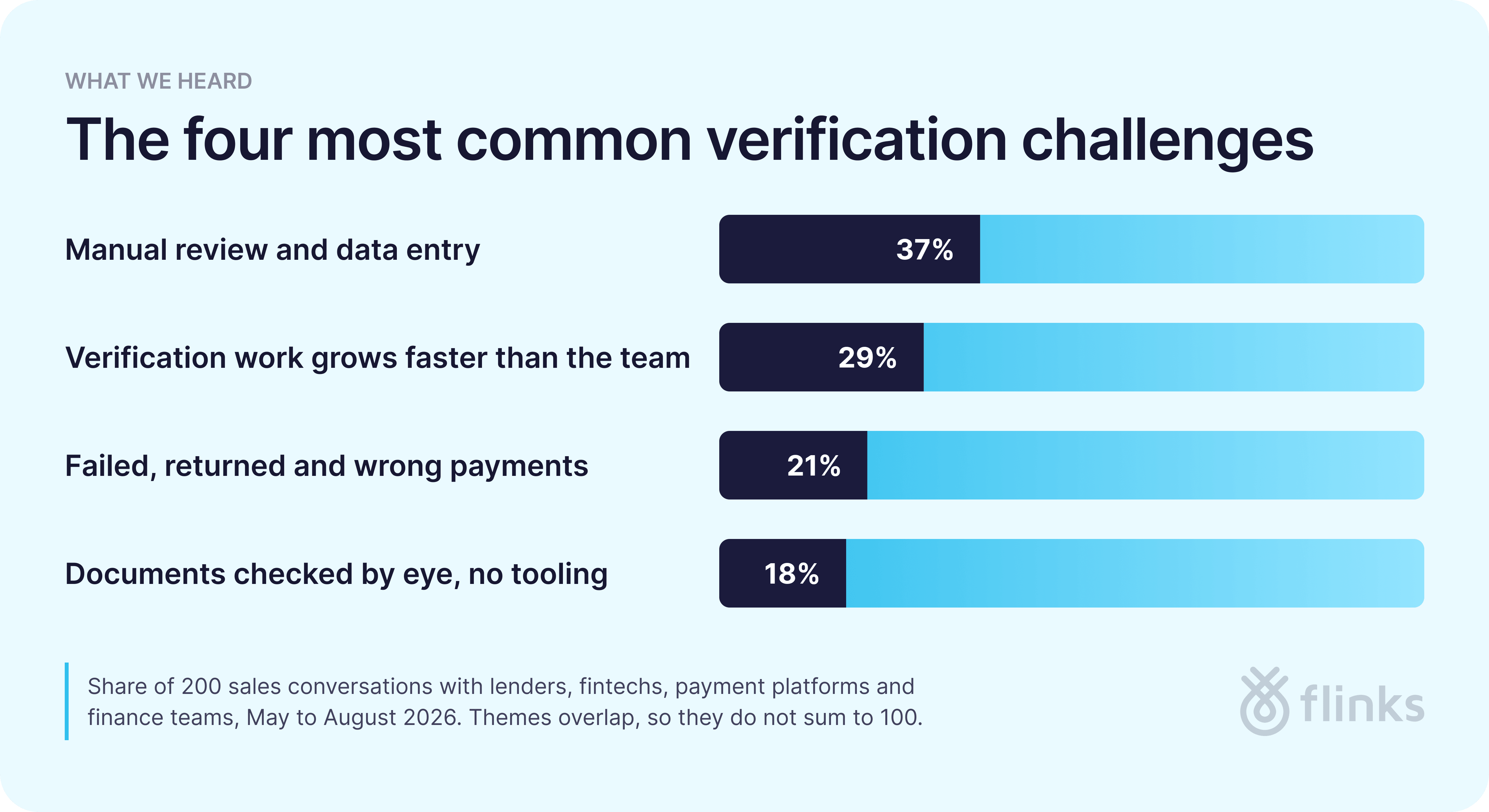
Someone is still typing it in by hand (37%)
Members mail void cheques to a benefits organization; someone opens the envelopes and types in the numbers. Applicants email PDFs to a mortgage lender; someone uploads them and types in the numbers. Everyone involved knows it's tedious.
Retyping isn't the expensive part, though. One consumer lender has applicants walk in with printed statements and a void cheque, and whoever is at the desk decides from them — their words were gut feel. That happens a few hundred times a month, and the file never records how the decision was reached. The same application can get a different answer depending on the day and who reviews it.
One commercial lender: "We don't want to spend three to five hours scrubbing statements only to decline the file." The hours aren't really the problem. Finding out at the end is.
Verification volume doubles. The team doesn't. (29%)
A payments platform went from around two thousand checks a month to four thousand in half a year, same process throughout.
Nothing broke. That's the part that makes it hard to raise internally — no incident, no backlog anyone can point at in a board deck, just a function quietly eating twice what it used to.
29% of calls described some version of this. A bank named manual document collection and underwriting review as the specific thing keeping it from scaling. A B2B finance platform told us 10 of its 12 customers lose two or three days a month matching transfers to invoices by hand; and it’s a cost they're currently absorbing on their customers' behalf, until one of those customers runs the numbers.
Failed and returned payments, weeks later (21%)
A payroll platform explained why their payments fail even when verification passes. They check the balance when the payment is initiated, but the money doesn't actually move for a few hours, and whatever else is queued against that account gets there first. The verification was accurate when it ran. A few hours later it wasn’t.
One property platform checks the balance over and over in the days before a debit goes out, purely so it doesn't get hit with NSF fees, and pays for every check. It works. They’re paying to work around a gap in their own data.Elsewhere, a large operator still has a small team opening void cheque images on screen and reading the digits off them — sometimes someone transposes two, and the payment lands in an account that isn't the customer's.
The cost shows up weeks later, on someone else's budget line, which is why nobody's tracking it.
Checking documents by eye, with no tooling (18%)
A credit union walked us through how it checks a statement it doesn't trust. Find a genuine statement from the same institution, hold the two side by side, look hard at the fonts. Spacing. Whether a timestamp is missing.
That holds until the other side gets better at it. A lender told us borrowers are submitting statements edited in PDF editors with the fonts matched properly, and the team can't currently tell. A tenant screening platform's document tool uploads and scans, and nothing else. One lender bought a document fraud tool, got false negatives in the scoring, and kept manual escalation on top of it (paying for the tool and doing the work anyway).
18% of calls, and it's the group I find hardest to watch. People who know exactly what they're looking for, with nothing to look with.
What they asked for instead
The most common ask, 38%, was for more applicants to get through the bank connection without falling out. Put that way, it sounds like a product feature, but the companies asking were talking about staffing: an applicant who can't connect doesn't disappear; they turn into an email someone has to open.
Another 36% wanted the manual step gone. Gone, not faster. A benefits organization put it as wanting account details to land in their finance system without anyone retyping them off a cheque stub.
About 30% didn't want raw transaction data at all — they wanted it already read. A tenant screening platform told us why: figuring out whether someone's income is self-employment, a pension, or dividends is genuinely difficult, and they had no interest in maintaining that as odd cases kept turning up. A payroll platform wanted NSF history for one specific purpose, which was to win an internal argument about shortening their processing window.
And a quarter wanted a record of what got verified and how. One professional services firm was running three processes across accounts payable, trust, and payroll that disagreed with each other.
Only 8% asked for faster decisions
Eight.
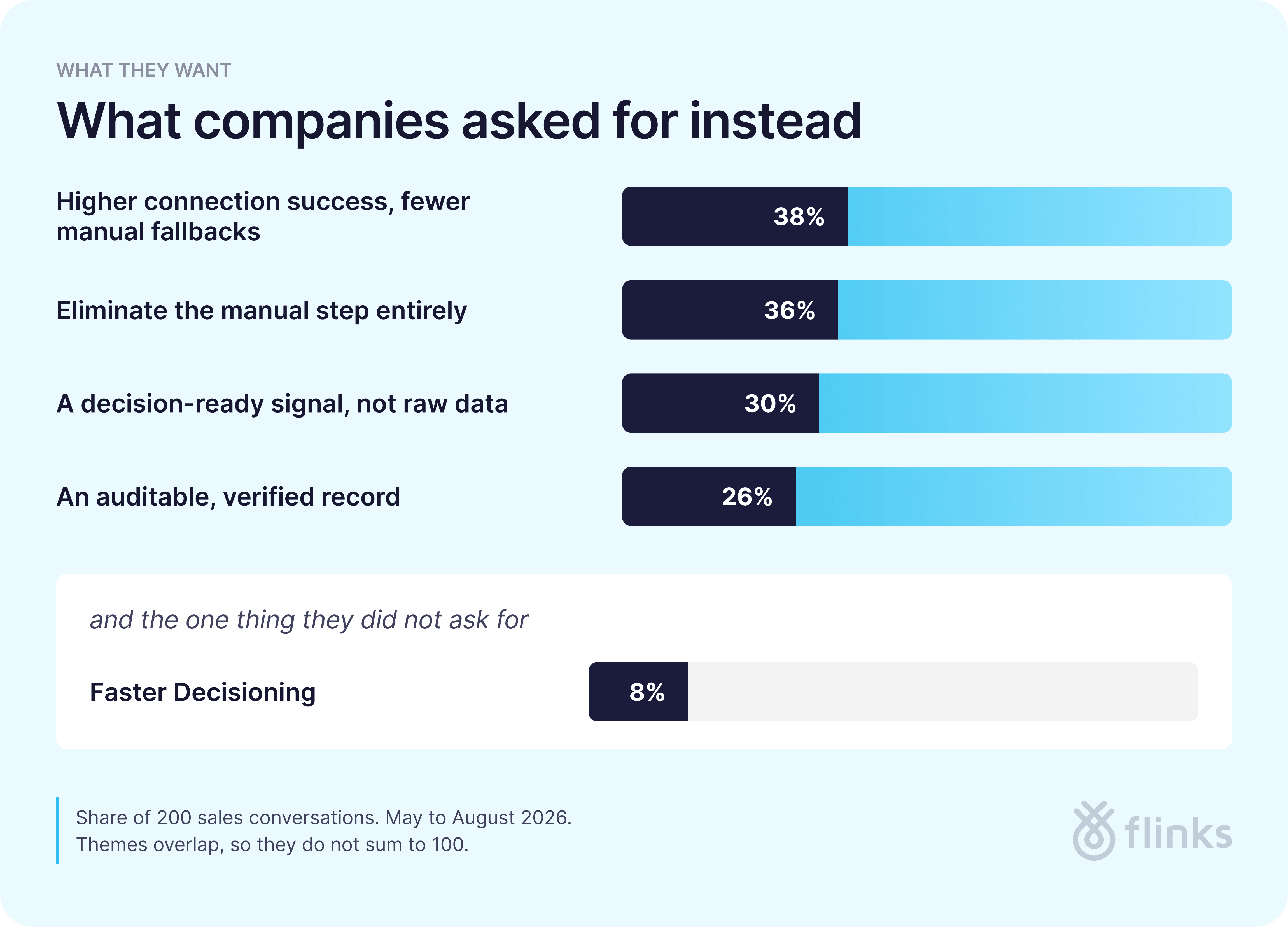
This industry has spent years selling speed (instant decisions, seconds instead of days), and the people running verification every day barely raise it. They want to stop doing it themselves. Decisions do get faster that way. It's just not what anyone's buying.
Two things to check in your own process
- Count how many points in your process stop dead without a person. Not how long each one takes — how many there are. The teams in the worst position weren't the slow ones; they were keeping up fine today and hadn't noticed that every new application arrives adds work for a person.
- Then find out what actually happens when a bank connection fails. If the answer involves an applicant photographing a void cheque, your connection rate is setting your headcount whether anyone has said so out loud or not. Same pattern we ran into looking at onboarding drop-off in Canada.
Where Flinks fits
Most of what's above is what we built the platform around. If borrowers are typing account details off a void cheque, Flink Connect verifies account ownership straight against bank data across 15,000+ institutions. Bank statements and documents that still arrive as PDFs go through Flinks Upload, which checks them for tampering so the decision doesn’t come down to someone squinting at a font. And the 30& who wanted data already interpreted rather than raw? That’s Flinks Enrich.
They sit together because of the 36% number. Automating most of a manual step doesn't remove it. It's removed when there's no gap left for someone to fill.
Thursday, September 24, 1:00 PM ET — Arber Ago and Misha Makarious are running a live session on scaling financial verification, including a scoring exercise for your own process. Register here.
If you want to go through your own setup, our client success team runs one-on-one reviews for customers and prospects. Talk to us.


.png)