
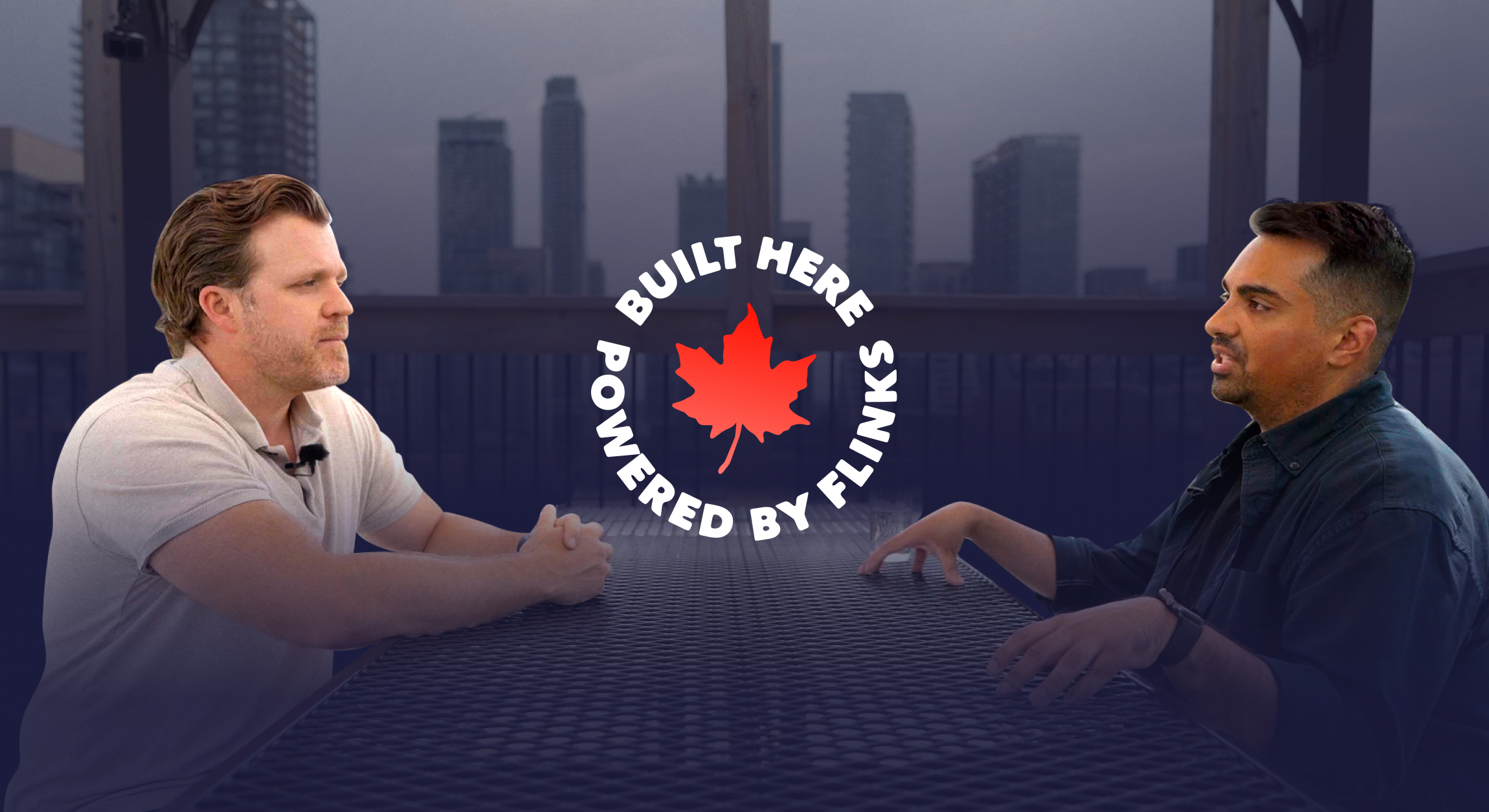

For 18 months, Venn had no customers. Saud Aziz and his co-founder, Ahmed Shafik, left well-paying jobs to build a business banking platform for Canadian companies, and they spent that stretch with two teammates in a windowless room, writing software nobody could use yet.
"We just had to keep reminding each other of the conviction of why we started because it was 18 months," Saud told me when we sat down on a Toronto rooftop for this episode of Built Here.
The build started around late 2021, which Saud remembers as the height of the fintech boom: "anytime you open TechCrunch, open any sort of tech news publication, you'll see this company just raised this big round." He called that period "quite stressful for us, thinking, like, are we really making the right move of investing in that infrastructure?"
He knew who he was building for. Canada's business population turns over constantly. In 2025, Statistics Canada put the business opening rate and the business closure rate at the same figure, 4.8% of active businesses (source). Saud described his early customers as businesses that "typically have one month's cash flow cycle." For a company like that, the payroll account has to work on the day payroll runs.
The decision underneath everything
Saud had built financial products twice before: first as an early employee at KOHO, then leading Revolut's Canadian expansion, where he met Ahmed. He said that experience gave him "a really good blueprint in terms of what it looks like to build the infrastructure." So the founders made the call early.
"We knew that we wanted to own the core infrastructure, things like we needed to own our own ledger because we wanted to offer a multi-currency offering."
A ledger records where every dollar sits and where it moved. When accounts, cards, and foreign exchange all write to one ledger, they agree by design. When each product keeps its own books, someone has to stitch them together afterward, and the stitching becomes the work.
Venn spent its first 18 months on that ledger before a single transaction ran through it, so the cards and currency exchange the founders planned to offer would write to existing books. I call that building the seam first. You design where your products connect before you ship any of them, so connection is built into the foundation and never needs retrofitting.
That choice had a price. Venn gave up early revenue and early proof while other companies announced milestones. Saud was clear about what the time bought.
"We knew that we wanted to do it because it'll allow us to move faster in the long term. But conventional wisdom would be like, move fast, break things, ship quickly. But we wanted to do things a little bit differently."
Connection runs outward too
A ledger connects a company's own products. A banking platform also has to connect to the institutions holding its customers' money. Saud said Venn works with most of the larger institutions, and those relationships are earned by showing you can meet the same obligations your partner does.
"If you show up to a bank and say, 'Hey, I'd like to use you to offer XYZ service,' and you don't know about KYC or KYB or sanctions, adverse media, perhaps all that sort of stuff, if you're not able to speak the same language, you're gonna have a really, really, really tough time."
Venn built that seam early, too. When it signed its first big-bank partner, Saud said, "We needed to show them that we had set up an application that meets all of their requirements."
Where the customer feels it
What a customer sees is whether their money shows up where it should. Saud watched for one signal above the rest.
"When I think of a business and their finances, they have two most important transactions that happen in a given month. One is their payroll." The other, he said, is "receiving that revenue payment, the one that the customers are sending funds to."
Payroll is money leaving the business. Revenue is money arriving. A business that routes both through a new provider has put that provider at the center of how it operates.
"Once I saw behavior change and customers start to trust us with those two most important transactions, I knew that we had built a product and sort of won that trust for them."
Venn just crossed 15,000 customers, with many arriving through word of mouth. Saud said he’s already looking at the next order of magnitude. "I'm really waiting for 100,000 and to learn more from there."
The question for builders
Saud’s test works for any financial product. Pick the payment your customer can least afford to see go wrong, which for most businesses is payroll, and follow it through your system from start to finish. Each time it changes hands, it creates a seam. Venn designed its seams before it had a customer to serve, and Saud expects that work to keep paying out in speed.
Saud's reasons for building trace back to his parents' jewelry store, where he grew up watching what a small business can do for a family. He says he is "always banging the drum for more entrepreneurship," and his advice to anyone weighing the jump is direct.
"You'll never be ready. You'll never have the perfect idea. You'll never know exactly how to go about it. There's never gonna be the right time. But if it's even a small idea in your head, you should absolutely go and do it."
Venn spent 18 months on a foundation before it served a single business. By Saud's count, that foundation now serves 15,000. He wants the gap between Canadian businesses opening and closing to keep widening. "We need those numbers to be as far apart as possible."
Saud's full story, from the back of his parents' shop to a ledger built before the first customer, is in the episode below.
Watch it, and the rest of Built Here: Canada's Financial Builders, at flinks.com/built-here. Episodes are also on YouTube.