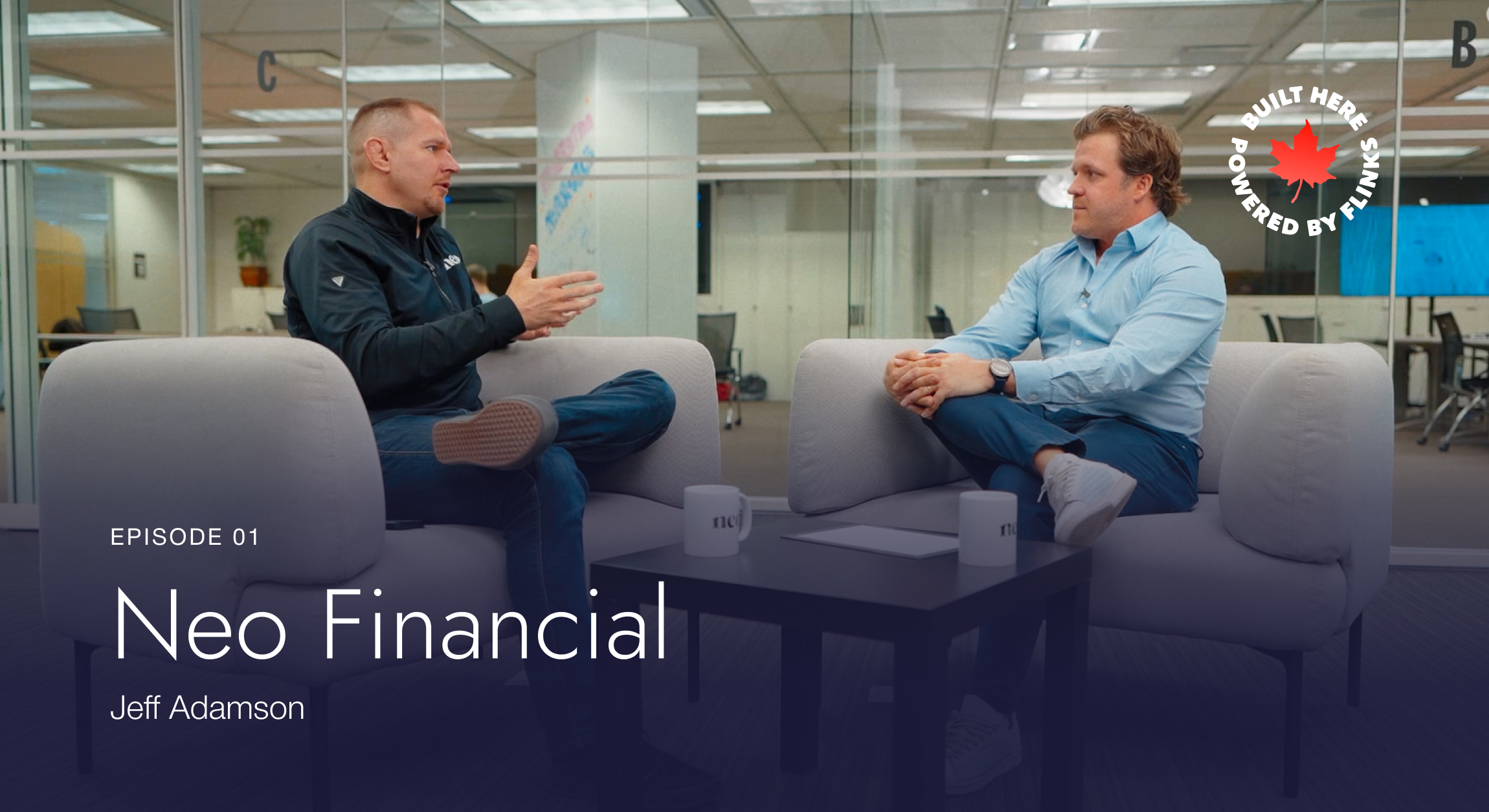

Earlier this month, we brought roughly 70 senior leaders from Canadian banks, fintechs, and platforms to the 36th floor of the TD South Tower for a closed-door conversation about something the industry tends to discuss in abstractions: why FI–fintech partnerships take so long, why so many don't make it, and what it actually takes to get one to revenue
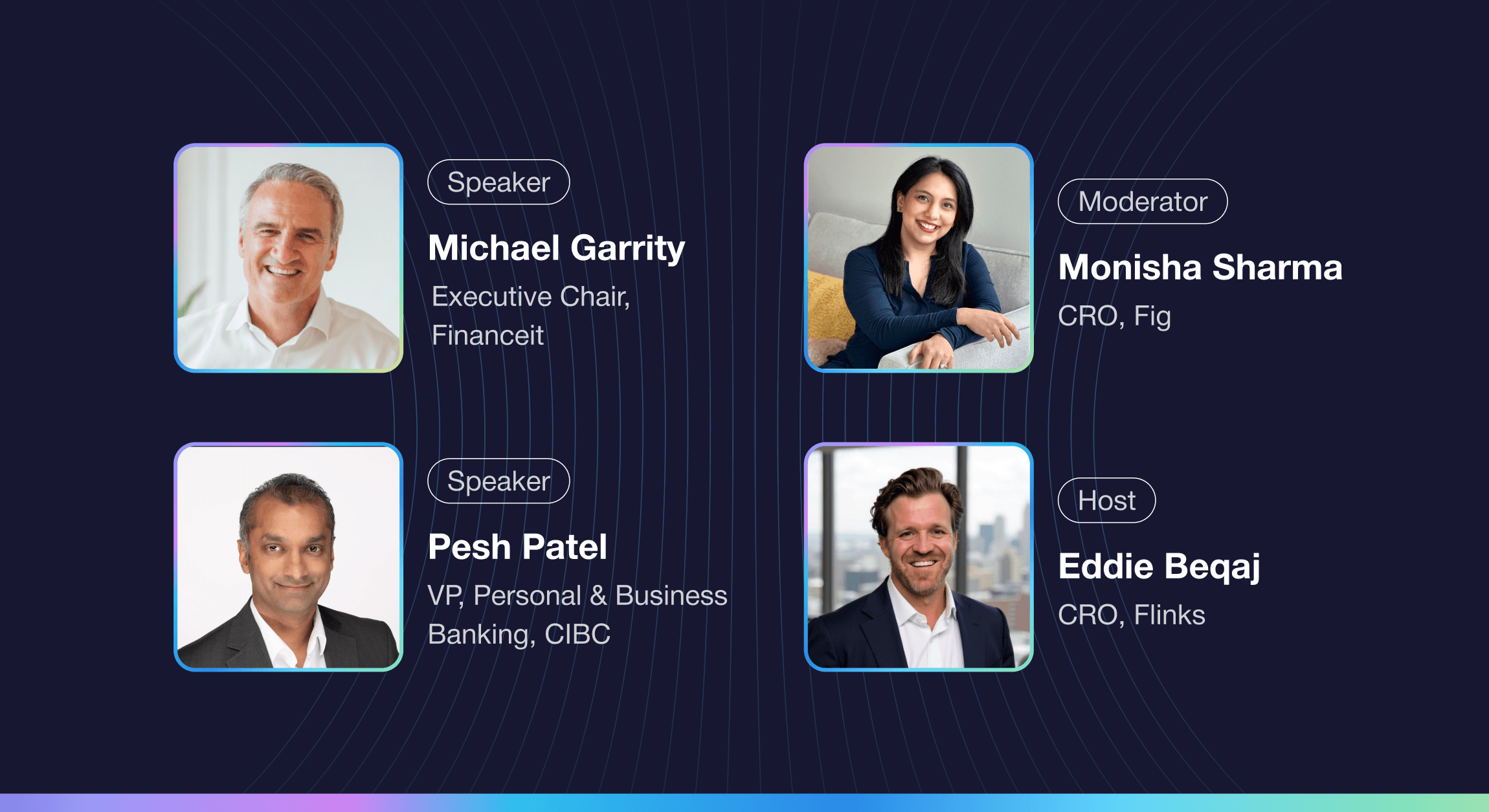
The discussion featured Pesh Patel, VP of Personal & Business Banking at CIBC; Michael Garrity, Executive Chair of Financeit; and Monisha Sharma, CRO at Fig, who moderated. Eddie Beqaj, CRO at Flinks, opened and closed the evening.
Watch the full panel recording below. The written recap follows.
The numbers that opened the night
Eddie opened with a coincidence: 24 and 24.
The first 24: the percentage of Canadians who switched bank accounts last year — the highest figure in 20 years of Environics tracking. The second: the average number of months it takes for a fintech and a financial institution to go from first meeting to signed partnership agreement in Canada. Of those attempts, 42% fail before the partnership becomes technically viable — not because of product-market fit, but because integration breaks down.
Those numbers set the frame for everything that followed.
Why banks actually partner with fintechs
Pesh was asked to strip out the strategic rationale and press release language and explain the real driver. His answer:
"We could do it ourselves, but it would take so long that everybody would have moved on by then. It's fundamentally about speed to market."
Michael offered the view from the other side. He described Canadian banking as deeply commoditized — institutions offering nearly identical products at nearly identical prices, competing for the same customers. Fintech partnerships are one of the few ways to build a defensible position in a specific part of the ecosystem. But that requires absorbing real risk, because if the opportunity were risk-free, a competitor would have already taken it.
The enthusiasm at a first meeting between a founder and a bank executive, he added, tends to narrow as more people enter the room — compliance, risk, vendor management, legal — each operating with a mandate to scrutinize rather than advance.
The first contract will not be a good contract
Michael's advice on early FI partnerships drew audible reactions from the room:
"Don't let perfection be the enemy of good enough. You're gonna get a contract that's one-sided. They can leave, you can't. One of your children has to be theirs. Close your eyes, sign it, get back on the street, try to do better on the next contract."
The first partnership is a survival exercise. The goal is to reach the second partnership, which will be better, and the third, which will be better still. At year 13, Financeit is still renegotiating its earliest relationships — now from a position of leverage they didn't have at the start.
The math is simple: if closing a partnership takes 24 months, you have almost no margin for error. Don't die is both the strategy and the metric.

Finding your champion inside the institution
Pesh made what several people flagged afterward as the most immediately useful observation of the evening: job title inside a large bank tells you very little about actual decision-making authority.
"Executives in banks have grand job titles — just like I've got a really grand job title, it's like 15 words — but it doesn't necessarily mean I have much authority to do anything. The hardest challenge is to navigate that jungle and find the right person who can actually make the decision. Otherwise you get 'we're really interested' for 12 months with nothing happening."
He drew a clear distinction between two modes of internal engagement. Passive support, where the contact can let a project die quietly without consequence. And an active mandate — "make this happen" — that shifts legal, compliance, and risk into problem-solving mode rather than blocking mode. Finding the latter, in his experience, is the variable that most determines whether a partnership advances past year one.
His most concrete suggestion: ask for a whiteboard. The best meeting he'd had recently wasn't a slide deck, it was someone drawing the technology architecture by hand and walking through the exact flow. That kind of clarity builds confidence faster than anything else.
Two partnerships from Financeit's history
Michael walked through two examples that illustrated what alignment (and its absence) actually looks like.
The deal that worked
Financeit had been competing against a major bank's point-of-sale lending business in the home improvement sector and winning consistently. An investor with deep ties to that institution suggested buying the business outright. The bank was willing, but required Financeit to also acquire a $350 million loan book — capital they didn't have. They structured a solution: a separate banking partner purchased the loans at par, covering both the acquisition and working capital for future originations. Financeit doubled its enterprise value with no cash out of pocket. Michael said he'll never structure a smarter deal.
The deal that didn't
A large U.S. investment bank became a majority investor and proposed expanding Financeit into the U.S., tied to its consumer banking platform. Two years and $10 million in sunk costs later, they called on a Friday afternoon to say they were ending the project and putting Financeit up for sale. The consumer platform had made the same promise to several other companies; Financeit was far down the priority list. The reason for the exit: the bank's new CEO had acquired a U.S. company operating in the same space, making the Financeit partnership a direct conflict of interest — something Financeit had no visibility into until that call.
The contrast, in Michael's telling, came down to interest alignment. In the first deal, everyone needed the same outcome. In the second, the investor's own strategy had shifted in a direction that made the partnership a liability, and Financeit was the last to know.

What success looks like — and when
When Monisha asked what success actually means in an FI–fintech partnership, the answers varied more by stage than by perspective.
Pesh was characteristically direct: "You both make money and nobody goes to jail." The levity landed, but the point behind it was serious — risk management isn't bureaucratic friction, it's the operating condition that makes any partnership possible inside a regulated institution.
Michael's answer was more staged.
- Early: don't die.
- Growth: accumulate enough leverage to renegotiate.
- Maturity: expand the relationship beyond the original use case until the fintech is solving multiple problems across the institution, not just one narrow one.
Acquisition or sustainable independence at scale are both valid outcomes — Canada needs more of both, in his view.
The specific difficulty of Canada
Several Q&A exchanges turned to why this is harder here than it is in the United States.
Monisha framed the consumer dimension directly: the Canadian purchase lifecycle runs two to three times longer than in the U.S. During COVID, a third of Canadian retail branches had to remain open because consumer demand required it. In the UK, 80% of credit cards are now purchased online; Canada was at roughly 30% pre-pandemic. "Canadians would rather die than not go to a branch," she said. "That's a different consumer, and that makes building a high-growth business here very difficult."
Michael noted the capital gap: U.S. venture funding runs roughly 100 to 1 relative to Canada, and the U.S. has more than 4,000 competing banks versus six dominant institutions here.
Pesh was candid about the regulatory environment. Open banking legislation has been in development for six years, and the absence of a clear standard has a real cost: "Just pick something and let us get on with it. Those sparks die before they get a chance to participate." But he was equally direct about his optimism — he doesn't believe it takes 20 years for Canadian consumer behaviour to shift. It takes one or two significant catalysts, and in his view the conditions are closer than they've ever been.
A note on why Flinks hosted this
We put together this conversation because it sits at the centre of what Flinks does. As an embedded finance platform, we bring together connectivity, intelligence, and payments for the financial institutions, fintechs, and platforms building on top of us — without competing against any of them. The partnerships discussed in that room are the ones our platform is built to support.
.webp)

.png)